
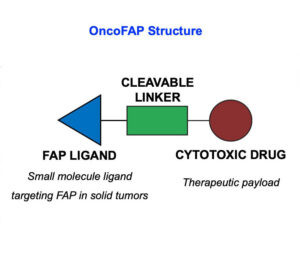
OncoFAP-GlyPro-MMAE is a small molecule drug conjugate with ultra high affinity for Fibroblast Activation Protein (FAP), an antigen overexpressed in more than 90% of epithelial cancers. OncoFAP-GlyPro-MMAE consists of (i) a small organic ligand targeting FAP, (ii) an innovative cleavable GlycineProline linker, and (iii) the cytotoxic payload monomethyl auristatine E (MMAE).
The cytotoxic payload MMAE is inactive when bound to OncoFAP via the GlycineProline linker. Proteases in the tumor microenvironment (such as the target protein FAP itself) cleave the linker, thereby releasing the now active MMAE.
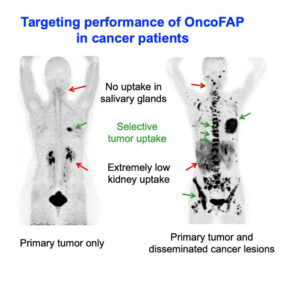
Using mass spectrometry methodologies, we confirmed in mouse models of cancer that OncoFAP-GlyPro-MMAE selectively delivers MMAE to the tumor while showing extremely low uptake and release in healthy organs. This efficient release of MMAE in the tumor microenvironment coincided with a potent anti-tumor activity.
Since FAP is overexpressed in more than 90% of epithelial cancers (e.g., malignant breast, colorectal, ovarian, lung, skin, prostate and pancreatic cancers, as well as in some soft tissue and bone sarcomas), we are developing OncoFAP-GlyPro-MMAE for the treatment of different solid tumors.
The molecule is being studied in a Phase I clinical trial in animal patients (dogs with spontaneous tumors). Preparations for a First-in-Human trial are ongoing.

References
Bocci et al. (2024) J Control Release, 367:779
A Comparative Analysis of Fibroblast Activation Protein-Targeted Small Molecule–Drug, Antibody–Drug, and Peptide–Drug Conjugates
Zana et al. (2023) Bioconjug Chem. 34(7):1205-1211
Fibroblast Activation Protein Triggers Release of Drug Payload from Non-internalizing Small Molecule Drug Conjugates in Solid Tumors
Zana et al. (2022) Clin Cancer Res, 28(24):5440-5454
Translational imaging of the fibroblast activation protein (FAP) using the new ligand [68Ga]Ga-OncoFAP-DOTAGA
Backhaus et al. (2021) Eur J Nucl Med Mol Imaging, 10.21203/rs.3.rs-969176/v1
An ultra-high-affinity small organic ligand of fibroblast activation protein for tumor-targeting applications
Millul et al. (2021) PNAS, 118, 16, e2101852118