
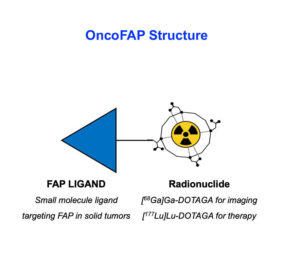
177Lu-OncoFAP-23 is a small molecule radiotracer with ultra high affinity for Fibroblast Activation Protein (FAP), an antigen overexpressed in more than 90% of epithelial cancers. The product consists of (i) a small organic ligand targeting FAP, (ii) an innovative spacer structure and (iii) a DOTAGA chelator for the incorporation of 177Lutetium.
177Lu-OncoFAP-23 displays best-in-class performance both in vitro and in vivo with the highest reported affinity to the FAP antigen. The product has shown a rapid and selective accumulation in the tumor mass in preclinical models of cancer, with an extraordinarily long tumor residence time.
177Lu-OncoFAP-23 has demonstrated a strong anti-tumor efficacy in mouse models of cancer, even at very low doses (5 MBq per mouse). This potent anti-tumor effect was further enhanced when combined with tumor-targeted proinflammatory cytokines (e.g., L19-IL2).
FAP is expressed in more than 90% of epithelial cancers (e.g., malignant breast, colorectal, ovarian, lung, skin, prostate and pancreatic cancers, as well as in some soft tissue and bone sarcomas). Therefore, Philochem is developing 177Lu-OncoFAP-23 for the treatment of various FAP-expressing solid malignancies. A first-in-human trial with 177Lu-OncoFAP-23 alone and in combination with the immunocytokine L19-IL2 has been approved by regulatory authorities.
ONGOING CLINICAL TRIALS
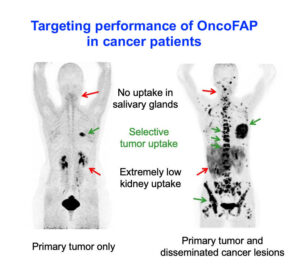
- OncoFAP-68Ga has recently entered in a first-in-man imaging study in patients with advanced solid cancers
- Additional studies with OncoFAP-68Ga (Imaging) and OncoFAP-177Lu (Therapy) are about to start

References
Molecular Evolution of Multivalent OncoFAP Derivatives with Enhanced Tumor Uptake and Prolonged Tumor Retention
Galbiati et al. (2024) J Med Chem. 67(15):13392
Preclinical Evaluation of 177Lu-OncoFAP-23, a Multivalent FAP-Targeted Radiopharmaceutical Therapeutic for Solid Tumors
Galbiati et al. (2024) J Nucl Med, 65(10):1604
Puglioli et al. (2022) Chem, doi: 10.1016/j.chempr.2022.10.006
Galbiati et al. (2022) J Nucl Med, numed.122.264036
Backhaus et al. (2021) Eur J Nucl Med Mol Imaging, 10.21203/rs.3.rs-969176/v1
Millul et al. (2021) PNAS, 118, 16, e2101852118